AN INTERNATIONAL POETRY JOURNAL IN ENGLISH & CHINESE
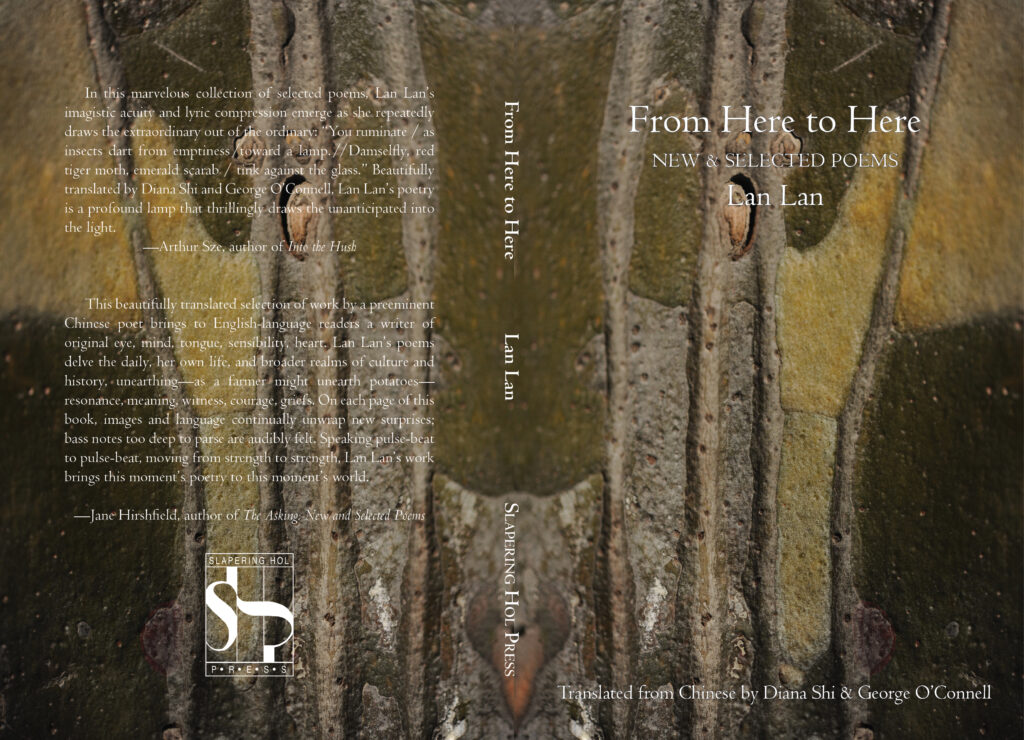
From Here to Here: New & Selected Poems by Lan Lan
Edited & Translated by Diana Shi & George O’Connell
Published by Slapering Hol Press
ISBN 978-1-940646-20-6
Contents
Sample Poems
Errata
Buy the Book
Contents
CONTENTS
Preface by George O’Connell
INNER LIFE (1997)
Wild Sunflower
In My Village
Rain in a Small Town
Spring Night
Ruins, Big River Village
DREAM, DREAM (2003)
I Am Other Things
Siesta
The Rest of It
Wind
Insomnia
Danger
Learning: The Beautiful, The Lustful
Under the Pillow
Discovery
Mother
Shadow and Its Establishment
PSALTER (2006)
Death of a Shoemaker
Useless Things
When I Sing This Song
Living Night
My Sisters
The Dead
Unfinished Journey
A Poet’s Work
Archangel
Pont Marie
Karamay
FROM HERE TO HERE (2010) & SING SORROW (2017)
Train, Train
Truth
Some Thoughts
Carpenter amid Woodshavings
Patience
Egret
Clown Song
HARBOR OF THE WORLD (2018)
Poet
Weeds and Stars
A Way to Write Poetry
Your Pretty Lips
Secretly Besotted
Wedding of Ideas
Neither Tapwater nor Faucet
Temple Ji Di
My Love Is a Tree
Passing Through Customs
Ruin
Written for a Woman Poet
BACK FROM THE MUSES’ VALLEY (2018)
Areopagus
At Socrates’ Cell
Honesty
Helicon
Dark Motive
Cricketsong
Of Course You’ll Say
Beauty
HAIHE BALLAD AND THE LYRE (2021)
The Ocean Plays Its Wavy Record
Outside the ICU
Soliloquy Before Sleep
Someone
We Only Live
What Makes a Difference
Light and Lamp
You Don’t Have
Red Deer Cave
Bronze Kneeling Figure Lamp
Need
Children
NEW POEMS (2000–2024)
Breakfast of Sentiments
Wet Market
Modern Life, Train G1587
Lockdown Zone
Quarantine Shopping List
Ethical Economics
Pensive
Bees
Stoicism
No Doomsday
NOTES
ACKNOWLEDGMENTS
Sample Poems
For readers’ interest, below are the translators’ preferred versions of some Lan Lan poems. Others appeared in Pangolin House Winter 2012-13 Issue.
RUINS, BIG RIVER VILLAGE
Back in Dahe Village.
Silent crows atop tall cottonwoods.
Past the threshing ground, sparrows stream,
wings gilt with wheatdust.
They see me.
The same breeze rises
as if I’d never left.
Have I changed?
Sunset, trees’ long shadows
trying for the dunes,
again the hour of cooking fires.
At the field’s edge trudge farmers,
hoes upon their shoulders,
and oxen, their same backs
green with bound grass.
I step clear.
How time flows by unbroken
in Dahe Village, the big river
still rolling.
I AM OTHER THINGS
I’m the fruit of my own flower.
I’m the frost and snow after spring and summer,
crone and beauty
of my youth.
I am other things.
I’m the book I once read,
the walls I leaned on, the pens, the combs.
I’m the mother’s breasts and her infant’s mouth.
I’m the leaves, after many storms mouldered.
I’m the black soil.
DANGER
Quite likely, I’m what you hope for—
a plant of the greenest grass, not the fabled beauty
of wind bending to your dream.
I’m the look of your finger, light across your forehead,
your morning scent, the eye
that carries grief.
Here lurks ambush,
the dead spot between heartbeats, the disappointing
groan, the autumn barn
without one grain of harvest.
I am your cooling fingertip, a zero
lacking a remainder, not even “no.”
I’m neither my object nor a dubious self
but you dear—
your drought, your rainstorm,
your old enemy, for generations
your kinsman.
DEATH OF A SHOEMAKER
At dusk, near the edge of Xuying Village,
he sets down the manure bucket.
A shoemaker, doing a craftsman’s work
for his brothers.
The wooden last grows tedious.
Black mire shoves through toes open to sorrow;
poverty exacts its old payment from the pen.
Heavy rain. Tattered rustling
at paper windows. Wind rips a gap
between him and the seats
of the provincial office.
Green, cold, the ridges of the turnip field
staggered with footprints.
No longer will he tie
the ox to the schooldesk.
He wished only to smile, and
did. Above the icy kerosene of an ink bottle
burns the silent wick. No patch can hide
what violence has torn. Hammer’s head.
He sews night and rain
for a legacy none redeem:
on the anvil a pain-forged nail
pounds through his skull.
Only worn-out shoes know his name:
Xu Yunuo, Henan poet, died 1958.
Barefoot, called lunatic,
his bouquets all in the future,
he drifted over hills and plains. Behind him
came mountains.
ARCHANGEL
The Seine slides beside you.
A windgust blows your hat
to a village in north China
as the sun drops,
fire banked in a lime kiln.
The low river shows its smooth stones,
serene as the noon breath of cattle.
Never in this world have I met
an archangel. In human form, the wings
stay hidden. But when they open,
night rises toward starlight. How brief our lives
feeding on lichens of the real.
“Is that you?” he asks.
At Place du Châtelet, a flash of light
as he trades wings with evening
while a soundless river flows within.
Nearby, the tower’s half-ladder trembles,
retreating into clouds. Time’s hourglass slows
as earth’s grim scars
are mantled by his wings. Grief
weighs down a rebel’s eyelids.
Ruined walls, paper scraps,
a chapter still unended.
Incompletion makes him whole, offsets
the empty Paris street. Archangel,
face dimmed by sunlight, shadowy lamps,
heavy yellow pages. He comes into focus
and the ancient grove appears. Low in the sky,
silence, then notes of a golden bell.
TRAIN, TRAIN
Dusk ships off white day. Windows fade
from the capital to the sullen twilight of North China.
From here to here.
On this great earth, roads gash poplar groves.
Thunder follows lightning
but our mouths are safely stopped.
The train crosses fields, pages of laboring feet erased.
We tremble, speak no more
of nodding sheep, thick smoke of brick kilns.
Wheels plunge through night. From here
to here. Imperishable stars
attend the long cortège
stretched on the rails of our courage.
Train. Train. Beyond the headlines,
we shiver through numb countryside:
this dying man, hoist by his heels,
gazing from the sky.
NEITHER TAPWATER NOR FAUCET
Neither tapwater nor faucet.
You know what I mean.
The well, the water bucket,
the slick stone terrace,
the long damp rope descending,
the deep chamber
hacked by thirst from darkness.
Some are less easy to see.
Those clouds and stars.
Those startled or desperate faces
peering in.
AREOPAGUS
Stone steps worn smooth by countless feet
still teach their hardness.
No spears or arrowpoints. Only the fiery sunset
kissing the Hill of Ares.
Lovers lean close for the camera. The young
ascend—wind finds
these shining foreheads.
Their looks, their tones carry
on the breeze. A lithe dream
lifts Ares’ weighty armor—
its heft soaring into wings,
its blacksmiths chorus for the flames.
Show me the rock
where St. Paul stood, show me
the wanderers of Athens’ streets and bazaars.
I never loved the crowd. At home I love
the beggars like old dogs, the man playing sanxian on the overpass,
someone from Henan humming Roll up the Reed Mat,
the street sweeper, the woman teacher in a mountain village,
the man nodding off on the phone to his lover,
each of them, man and woman,
not the mass, not the people.
Show me please, the nearby theater of the Acropolis,
soon flooded by night’s tsunami.
In line with your finger, staring with your eyes, I burn
a scorched aperture:
the stars a comb clotted with gold bees,
humming the darkened sky.
AT SOCRATES’ CELL
The day begins at twilight,
the tints of dusk deepening
before iron night drops down its bars.
The pine tree drapes its boughs so lightly
on the shoulders of a man sunk in shadow.
From the cell’s stone windowsill, a lamp?
Somehow you taste in that bowl
sweet hemlock’s uncanny joy. Dawn breaks
the moment death steps to nothingness,
and sunrise mounts the dial.
You’ll keep learning to love despair, till blood-smeared hope
slides from pain’s womb.
In the old days, you’d read his
shining words, on the mortal path
at the cliff of freedom.
Others bear with you the hard fate of thought,
as now you’re seated on cold stone, and a black dog
lopes. Through each of us Socrates passes,
mute, gently smiling.
Listen! A bell. Vespers.
SOLILOQUY BEFORE SLEEP
From the half-open window I hear
not merely a bay, but a tide
broader than this Yellow Sea—
the Pacific, that boundless, terrible,
bottomless ocean we can only guess.
On its floor, countless shipwrecks,
yet even past the Pacific I hear
this liquid governess of earth.
From space, we’re stunned
by such unspeakable blue.
Like everything we can’t describe,
it nurtures life and devours it,
refusing our lifebreath,
refusing four-footed beasts.
All languages should be writ on water,
washed by waves, as truth
refuses the ambition to be truth.
Perhaps the ocean will request
a final dance, when I no longer
need anything. I love and respect
what I avoid, yet my own breath longs for.
The sea dictates its freedoms and low places,
how anger offsets peace,
arraying the strengths of the universe:
great storms, hurricanes,
azure-stilled skies.
And here a small bay, its murmurs
stroking my forehead toward sleep,
how its back bears me softly
toward the first glint of sunrise.
WE ONLY LIVE
We live only as far as we can see,
at most to the edge of what we imagine.
No one’s exceptional.
Emperor, professor, farmer, sailor,
each lives in his own house:
a chair, a desk,
a piece of land, a few acres of ocean.
No one’s exceptional.
But when screams and blood
spill from your cellphone,
or someone you know disappears with no trace—
facts may stun you.
Philosophers bathe in their bookcases.
In lines remarkable but illogical,
poets lie supine.
YOU DON’T HAVE
You don’t have a God
to ask for help
nor a merciful Bodhisattva
watching from mid air.
Sometimes you run to the field, desiring
thought’s gold grain amid the wheatstalks,
or an image rustling emerald in the corn.
Above the waves of wheat surging toward the skyline
you see where earth ends, and the universe begins.
Sometimes both appear, opening
vastness within vastness, a glimpse
of secrets made clear, there in the wheat,
behind green curtains.
Are you one of them?
From grains and kernels countless
as a populace, in you all this
the silent life of the world,
its death, its birth, rebirth.
Balsam poplars stretch toward emptiness,
high waterfalls leap toward earth,
breaking to vapor.
In your dream of weaving yes with no,
doubt makes its visit—first as office secretary
to a seedgrain now awaiting spring
and the emergence of some God, some Bodhisattva.
CHILDREN
Children no longer recognize potato leaves,
peanut vines, or millet.
Cellphones are their field,
their human world and desert empire.
They own words, images,
digital toys, electronic dogs.
Adieu—from you they’ve moved next door.
Their Provence has no Vincent van Gogh,
their lavender is Alipay.
An ancient castle where the imprisoned wailed
and Dante was exiled
overlooks sheer cliffs.
Children know none of this. The high wall,
Cavafy said, is built by us.
Death perhaps might wake them.
You pray softly on scarred knees.
MODERN LIFE, TRAIN G1587
Snow, but I imagine spring,
dandelions in central China,
Siberian elms on the south bank of the river Huai
sprouting new samaras.
And in Henan, my friend with Covid
still sealed behind his door.
I imagine late February,
the seals across this land torn open,
its seasons more reliable
than people’s fears, each grass slope
greater than the crumbling moral order,
despite the masked still wailing
and discarding innocent lives.
Imagine a night train cutting across north China,
past hibernating wheat, cabbage rows.
A young man hunched over his cellphone, faithfully
joining his girlfriend in flight. Deep into darkness
the God of Death touches every mask,
shutting every exit, this huge web of iron
snaring the same prey that hail its atrocities.
Imagine inhabiting music that grants
a moment’s false happiness. How the ticking snow,
the tacketing rain, might frame human dignity;
days of silent humiliation a true emptiness.
As in a song, the river of rushing youth,
though stippled with ice,
cares nought about cold.
Its ardor sears the eyes that see.
Like a lover, imagine
the bloom and fruit of an apple tree,
the poet sharpened by these times,
but who cares to be Du Fu—that bitter reputation.
Talent swells in abjection,
despair, a son’s bereavement.
When midnight’s hand passes the Yellow River,
hometowns panicked, train and air tickets gone,
map the virus on TikTok and Weibo.
How inhuman this world,
women losing their unborn,
the aged dying alone.
Trees of the season to come,
speak what I imagine. This Spring Festival
if I raise my two hands to heaven,
what may I grasp?
Perhaps in a string of words
the faith of hope insistent,
born in us each,
framed by what we are together,
cursed by “You deserve your fate.”
PENSIVE
Maybe language is its own end. Maybe not.
In dreams I return to the sea of my childhood.
Its waters lap my pillow, wet my cheek.
The mountain I’ve climbed sinks toward the ocean floor.
Sometimes I see my beloved dead, waving.
Once, I owned a proper desk. Hard to now imagine
if I got lost at a three-way junction
in Henan, or bought one more book in a shop,
would I be here? I live
not knowing tomorrow.
I can’t write novels, so my trail stays secret,
along which snowmen cunningly enter a tale.
About myself I know so little.
Lured by different lamps, I turn left or right.
Humming, I wash strawberries and apples for my daughters.
At a banquet once, I found myself surrounded by strangers.
Once I ate half a squirming worm.
Autumn’s the season to write. I spent 32 years
carrying the most difficult poem
like a pregnancy.
I don’t know when the terminator will knock on my door
holding one map. Often at night
I search the sky for a single star.
Sometimes I’m in love with the landscapes in Isaac Levitan’s paintings,
sometimes not—if a shepherd’s-purse flower
touches my eye, or a chain.
I often wish I were religious.
Is that the root of misfortune?
I detest some poems I’ve written,
which now leap up to bite. I’m torn by hesitation,
wrath, shameful cowardice.
Tenderness for me is invincible.
I’ve heard the spokesman of the Ideal Museum
wail for whatever died before it lived.
How lucky I’ve never owned an inch of land,
but have two well-fitting shoes.
Neither proprietor nor tax collector,
I grasp my pen as a humble refugee,
a stowaway in time.
Errata
TRANSLATORS’ PREFERRED SPELLING AND PUNCTUATION:
p.19 Ruins, Big River Village: “wheat dust” should be “wheatdust”
p.23 I Am Other Things: “moldered” should be “mouldered”
p.25 The Rest of It: “soft-fallen” should be “softfallen”; “forest keeper’s” should be forestkeeper’s
p.26 Wind: “sand grains” should be “sandgrains”
p.37 Death of a Shoemaker: “school desk” should be “schooldesk”
p.43–44 Unfinished Journey: “window glass” should be “windowglass”
p.46 Archangel: “wind gust” should be “windgust”
p.48 Karamay: “thirty-seven” should be “37”
p.51 Train, Train: “Thunder follows lightning,” should be “Thunder follows lightning” (no comma)
p.54 Carpenter amid Wood Shavings: “wood shavings”, title and text, should be “woodshavings”; “wheat stalks” should be “wheatstalks”; “cook smoke” should be “cooksmoke”
p.67 Neither Tap Water nor Faucet: “tap water”, title and text, should be “tapwater”
p.75 Areopagus: “Show me, please,” should be “Show me please,”
p.76 At Socrates’ Cell: “shining words on the mortal path” should be “shining words, on the mortal path”
p.87 Soliloquy Before Sleep: “not merely a bay but a tide” should be “not merely a bay, but a tide”; “life breath” should be “lifebreath”
p.89 We Only Live: “cell phone” should be “cellphone”
p.92 You Don’t Have: “midair” should be “mid air”; “wheat stalks” should be “wheatstalks”
p.97 Children: “Cell phones” should be “Cellphones”
p.103–104 Modern Life, Train G1587: “cell phone” should be “cellphone”
p.108–109 Pensive: “thirty-two” should be “32”; “How lucky I’ve never owned an inch of land” should be “How lucky I’ve never owned an inch of land,” (comma preferred)
Buy the Book
From Here to Here is now available from